Core Product Line
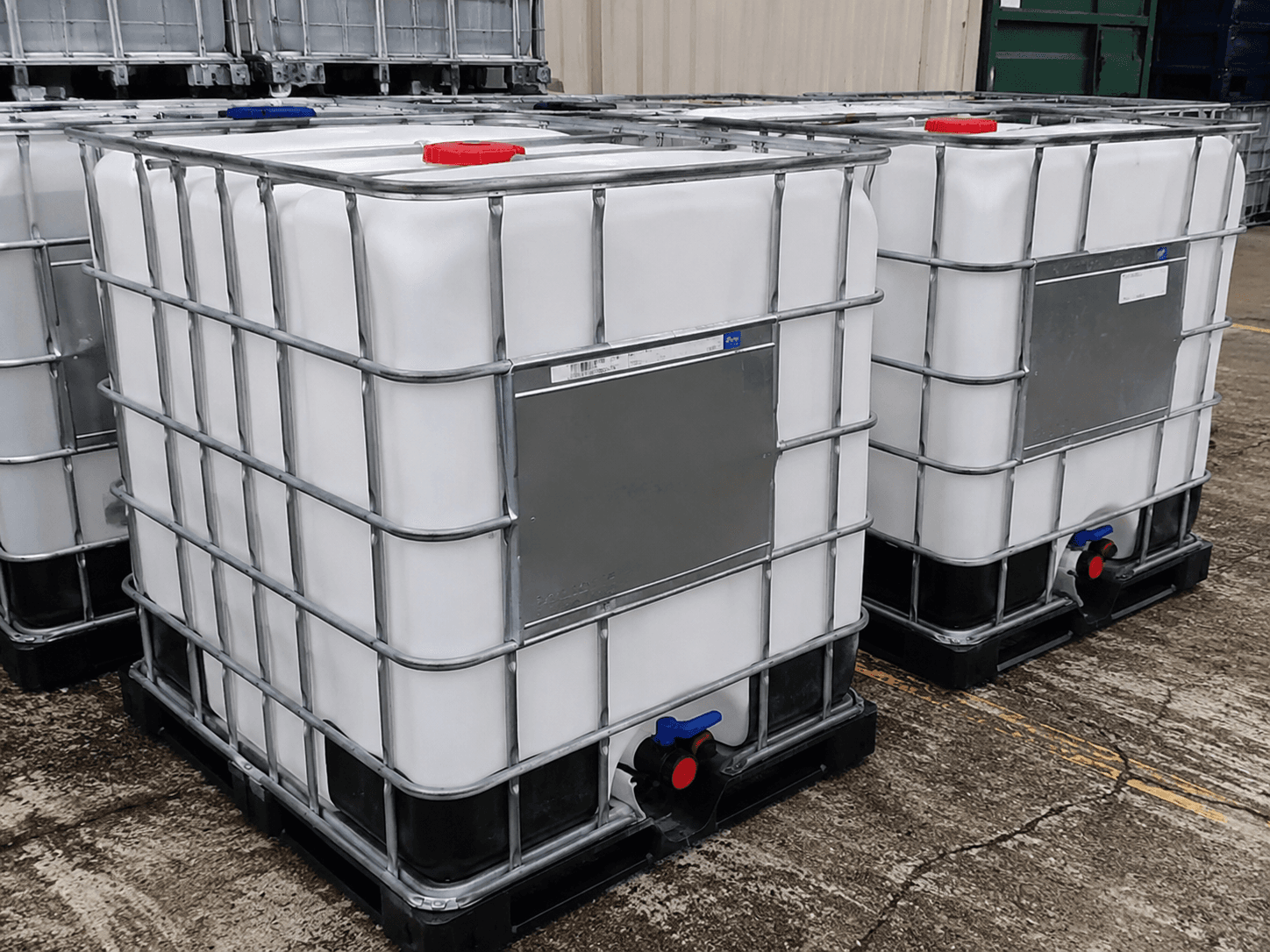
IBC Totes
Intermediate bulk containers in 275-gallon and 330-gallon capacities. Available in used, reconditioned, and new condition across food-grade, industrial, and chemical-grade ratings.
Understanding IBCs
What Is an IBC Tote?
An IBC tote -- short for Intermediate Bulk Container -- is a reusable industrial container designed for storing and transporting liquids and granulated materials in bulk. Unlike drums that hold 55 gallons, IBCs bridge the gap between barrel storage and full tanker loads, making them the most versatile and cost-effective bulk packaging solution in the industry.
A standard IBC consists of three primary components: an inner bottle made from high-density polyethylene (HDPE), an outer cage fabricated from galvanized steel tubing, and a base pallet constructed from wood, composite plastic, or steel. The bottle holds the product, the cage provides structural rigidity and stackability, and the pallet allows forklift handling and warehouse racking.
At Grand Rapids IBC, we specialize in giving these containers a second and third life through professional reconditioning, keeping thousands of units out of landfills each year while offering businesses significant cost savings.
IBC Tote Anatomy
HDPE Inner Bottle
Blow-molded high-density polyethylene container. UV-stabilized, chemically resistant, and FDA-compliant for food-grade applications. Wall thickness typically 2-3 mm.
Galvanized Steel Cage
Welded tubular steel frame with zinc galvanization for corrosion resistance. Provides crush protection up to 7,700 lbs static load and enables double-stacking when full.
Base Pallet
Available in wood (heat-treated to ISPM-15), composite plastic, or galvanized steel. Includes forklift pockets on two or four sides for handling flexibility.
Top Fill Opening
Standard 6-inch (150 mm) threaded fill cap on top for loading. Some models include a 2-inch secondary port for venting or sampling.
Bottom Discharge Valve
2-inch (50 mm) butterfly or ball valve at the base of the bottle for gravity-fed dispensing. Cam-lock adapters available for hose connections.
Technical Data
Detailed Technical Specifications
Comprehensive engineering data for both 275-gallon and 330-gallon IBC totes. Use these specifications for facility planning, load calculations, and regulatory documentation.
| Specification | 275-Gallon | 330-Gallon |
|---|---|---|
| Nominal Capacity | 275 US gallons (1,041 liters) | 330 US gallons (1,249 liters) |
| Maximum Fill Capacity | 275 US gallons at 98% fill | 330 US gallons at 98% fill |
| Outer Dimensions (L x W x H) | 48" x 40" x 46" (1,219 x 1,016 x 1,168 mm) | 48" x 40" x 53" (1,219 x 1,016 x 1,346 mm) |
| Tare Weight (empty) | ~135 lbs (61 kg) | ~145 lbs (66 kg) |
| Gross Weight (filled with water) | ~2,430 lbs (1,102 kg) | ~2,900 lbs (1,315 kg) |
| Bottle Wall Thickness | 2.0-3.0 mm (varies by manufacturer) | 2.0-3.2 mm (varies by manufacturer) |
| Bottle Wall Thickness Tolerance | +/- 0.3 mm | +/- 0.3 mm |
| Bottle Material | HDPE (High-Density Polyethylene) | HDPE (High-Density Polyethylene) |
| HDPE Density | 0.941-0.965 g/cm3 | 0.941-0.965 g/cm3 |
| Cage Material | Galvanized steel tubing (1.5 mm wall) | Galvanized steel tubing (1.5 mm wall) |
| Cage Wire Diameter | 4.0-5.0 mm | 4.0-5.0 mm |
| Zinc Coating Thickness | 60-80 microns | 60-80 microns |
| Fill Opening | 6" (150 mm) NPS / DN150 | 6" (150 mm) NPS / DN150 |
| Fill Cap Thread | S60x6 coarse thread | S60x6 coarse thread |
| Discharge Valve Size | 2" (50 mm) NPS | 2" (50 mm) NPS |
| Discharge Valve Type | Butterfly (standard), Ball (optional) | Butterfly (standard), Ball (optional) |
| Pallet Footprint | 48" x 40" (1,219 x 1,016 mm) | 48" x 40" (1,219 x 1,016 mm) |
| Pallet Entry | 2-way or 4-way (depends on pallet type) | 2-way or 4-way (depends on pallet type) |
| Static Top Load (stacking) | 7,700 lbs (3,493 kg) | 7,700 lbs (3,493 kg) |
| Maximum Stack Height | 2 units high when filled to capacity | 2 units high when filled to capacity |
| Specific Gravity Rating | Up to 1.9 SG (standard), 2.0 SG (heavy-duty) | Up to 1.9 SG (standard), 2.0 SG (heavy-duty) |
| Internal Pressure Rating | 1.0 bar (14.5 psi) standard | 1.0 bar (14.5 psi) standard |
| Hydrostatic Test Pressure | 0.2 bar (2.9 psi) for 10 minutes | 0.2 bar (2.9 psi) for 10 minutes |
| Weight Tolerance (tare) | +/- 5% | +/- 5% |
Environmental Performance
Temperature Ratings & UV Resistance
HDPE IBC totes are engineered for a wide operating temperature range, but performance characteristics change at extreme temperatures. Understanding these limits is critical for safe storage and transport, especially in outdoor or unheated warehouse environments.
Operating Temperature Range
-40 degrees F to 140 degrees F (-40 degrees C to 60 degrees C) for the HDPE bottle. For short-term exposure (filling operations), temperatures up to 160 degrees F (71 degrees C) are acceptable. Sustained temperatures above 140 degrees F may cause gradual softening and dimensional changes in the bottle.
Freezing Considerations
HDPE remains functional down to -40 degrees F, but if the contents freeze, the expanding ice can deform or crack the bottle. Always ensure fill levels allow for expansion (maximum 95% fill) if freezing is possible. Water expands approximately 9% when frozen -- a 275-gallon tote filled to capacity with water that freezes generates approximately 24 gallons of expansion force.
UV Resistance & Degradation
Standard natural-white HDPE bottles include UV stabilizers that provide 12-24 months of outdoor exposure resistance under typical conditions. After prolonged UV exposure, HDPE becomes brittle, yellows, and loses impact resistance. Black-tinted bottles offer significantly higher UV resistance -- up to 5 years of outdoor exposure. For extended outdoor storage, we recommend using an IBC cover (available in our accessories catalog) to maximize bottle lifespan.
Hot Fill Limitations
Standard HDPE IBCs support hot-fill applications up to 160 degrees F (71 degrees C). For product temperatures above this limit, metallic IBCs or lined stainless steel containers are required. Always allow hot-filled IBCs to cool before stacking to prevent deformation under load.
Lifespan Data
Expected Lifespan by Use Case
IBC tote lifespan varies significantly based on the stored product, environmental exposure, handling frequency, and maintenance practices. The following table provides estimated service life under typical conditions.
| Use Case | Est. Lifespan | Key Factor |
|---|---|---|
| Indoor food-grade storage | 5-8 years | Low UV, gentle chemicals |
| Indoor chemical storage (non-aggressive) | 4-6 years | Chemical compatibility |
| Indoor chemical storage (aggressive) | 2-4 years | Chemical attack on HDPE |
| Outdoor water storage (with cover) | 4-6 years | UV protection critical |
| Outdoor water storage (no cover) | 1-3 years | UV degradation |
| Agricultural field use | 2-4 years | UV, handling, temperature |
| Frequent transport / shipping | 3-5 years | Mechanical stress |
| Static warehouse storage | 6-10 years | Minimal stress |
| High-temperature products (100F+) | 2-4 years | Thermal cycling |
| Single-use / one-way shipping | 1 trip | N/A |
* Lifespans are estimates based on typical use conditions. Actual service life depends on specific product chemistry, environmental exposure, handling practices, and maintenance. Reconditioning can reset the clock -- a professionally reconditioned IBC can deliver performance comparable to a new unit.
Chemical Compatibility
HDPE Material Compatibility Chart
HDPE is chemically resistant to a wide range of substances, but not all chemicals are compatible. This chart provides general guidance -- always verify with the chemical manufacturer for specific concentrations and temperatures.
Compatible with HDPE (Safe to Store)
Not Compatible with HDPE (Do Not Store)
Important Note
These aromatic and halogenated solvents cause stress cracking, swelling, or permeation through HDPE walls. For these chemicals, stainless steel IBCs or specialty-lined containers are required. Contact our team for guidance on alternative container options.
Size Options
275-Gallon vs. 330-Gallon Totes
275-Gallon IBC Tote
1,041 liters | ~2,300 lbs filled with water
The 275-gallon tote is the most widely used IBC in North America. Its standard pallet footprint fits seamlessly into existing warehouse racking and truck configurations. This is the workhorse of liquid bulk storage, ideal for operations that need compatibility with existing infrastructure.
330-Gallon IBC Tote
1,249 liters | ~2,755 lbs filled with water
The 330-gallon tote offers 20% more capacity on the same pallet footprint by using a taller bottle. This means fewer containers needed per batch, reduced handling time, and lower per-gallon storage costs. Ideal for high-volume operations where maximizing payload per unit is critical.
Container Comparison
IBC Totes vs. Drums vs. Tanks
Understanding how IBC totes compare to other bulk liquid storage options helps you choose the most efficient and cost-effective container for your operation.
| Factor | 55-Gallon Drum | 275-Gallon IBC Tote | Poly Storage Tank (500+ gal) |
|---|---|---|---|
| Capacity | 55 gallons | 275-330 gallons | 500-10,000+ gallons |
| Cost per Gallon Stored | Highest | Lowest (for portable storage) | Low (but fixed installation) |
| Portability | High -- easy to move by hand | Moderate -- forklift required | Low -- permanent installation |
| Forklift Compatible | With drum handler only | Yes -- built-in pallet | No |
| Stackable | 4-high on pallets | 2-high when full | Not stackable |
| Truck Loading Efficiency | 4 drums per pallet = 220 gal | 1 tote per pallet = 275 gal | N/A -- not transported |
| Total per 53-ft Trailer | 80 drums (4,400 gal) | 20 totes (5,500 gal) | N/A |
| Dispensing Ease | Requires pump or tipping | Gravity-fed via valve | Pump or gravity via plumbing |
| Cleaning Difficulty | Difficult (small opening) | Moderate (6" opening) | Easy (large access hatches) |
| UN/DOT Certification | Available | Available | Not applicable |
| Reusable / Reconditionable | Limited | Highly reconditionable | Fixed -- not reusable |
| Floor Space per Gallon | Higher | Lower -- best space efficiency | Lowest (vertical tanks) |
When to Choose an IBC Tote
IBC totes occupy the sweet spot between drums and tanks. Choose an IBC when you need more capacity than drums can efficiently provide, but still require portability, forklift handling, and the ability to transport product between locations. IBCs are the clear winner when you consider total cost of storage per gallon, handling efficiency, and warehouse space utilization. A single 275-gallon IBC replaces five 55-gallon drums while using less floor space and requiring dramatically less labor to handle, fill, and dispense.
For operations that need more than 1,000 gallons of static storage at a single location, permanent tanks may be more appropriate. For small volumes under 55 gallons, drums remain the practical choice. For everything in between -- and especially for operations that need to move, ship, or reconfigure their liquid storage -- IBC totes are the industry standard.
Engineering Data
Stacking Load Calculations
IBC totes are designed for double-stacking (2-high) when filled to rated capacity. The galvanized steel cage transfers the load from the upper unit through the cage structure to the pallet and floor below, bypassing the HDPE bottle entirely. This means stacking integrity is determined by cage condition and pallet strength -- not by the bottle.
The standard static top load rating for IBC cages is 7,700 lbs (3,493 kg). This means a full 275-gallon IBC weighing approximately 2,430 lbs can be safely placed on top of another full IBC with significant safety margin. The stacking load of 7,700 lbs provides a safety factor of approximately 3.2x relative to the weight of a full 275-gallon unit.
For 330-gallon totes (gross weight approximately 2,900 lbs), the same 7,700 lb static load rating provides a safety factor of approximately 2.7x. Both sizes are rated for 2-high stacking when filled to capacity.
Empty IBCs can be stacked 4-5 high for storage, though practical limits depend on the structural condition of the cages. Reconditioned IBCs with Grade A or B cage ratings are fully suitable for stacking applications. Grade C totes with minor cage dents should be evaluated on a case-by-case basis for stacking suitability.
Stacking Safety Guidelines
Always stack on level, solid surfaces
Uneven surfaces create point loads that can buckle the cage or collapse the pallet. Use concrete or compacted gravel surfaces rated for the combined weight.
Ensure cage corners align vertically
The cage corner posts are the primary load-bearing members. Offset stacking shifts the load to weaker cage panels and risks structural failure.
Inspect cage and pallet before stacking
Bent cage members, cracked welds, or damaged pallet boards compromise stacking integrity. Replace damaged components before placing any IBC in a stack.
Never exceed 2-high when full
Triple-stacking full IBCs exceeds the rated static load and creates a significant safety hazard. Even if the cage appears to hold, long-term creep can lead to sudden failure.
Account for dynamic loads in transport
During truck transport, dynamic forces from acceleration, braking, and road vibration can exceed static load ratings by 50-100%. Secure stacked IBCs with strapping or containment systems.
Consider seismic zones
In seismic areas, stacked IBCs require additional restraint. Consult local building codes and OSHA guidelines for storage rack requirements in your area.
Rating Classifications
IBC Grade Types
Not all IBC totes are interchangeable. Selecting the correct grade ensures regulatory compliance and product safety for your specific application.
Food Grade
Manufactured with FDA 21 CFR 177.1520 compliant HDPE resin. These totes are suitable for direct contact with food products, potable water, beverages, edible oils, syrups, and food-grade chemicals. Our reconditioned food-grade IBCs undergo additional sanitization steps and are only sourced from containers that previously held food-safe materials.
Common uses: juice concentrates, cooking oils, vinegar, glycerin, potable water
Industrial Grade
General-purpose totes suitable for non-hazardous industrial liquids, cleaning chemicals, soaps, detergents, lubricants, coolants, and water-based solutions. These IBCs may have held a variety of non-food products in their previous life and are thoroughly cleaned during reconditioning but are not certified for food contact or hazmat transport.
Common uses: soaps, detergents, coolants, deicer, non-hazardous chemicals
Chemical Grade
UN/DOT rated totes designed for regulated and hazardous materials transport. These containers carry specific UN ratings (e.g., UN31HA1/Y) that certify them for particular hazard classes. Chemical-grade IBCs feature thicker bottle walls, reinforced cages, and tamper-evident closures. Available in new condition or reconditioned with re-certification.
Common uses: solvents, acids, bases, flammable liquids, regulated chemicals
Industry Applications
Detailed Application Guides by Industry
IBC totes are used across virtually every industry that handles bulk liquids. Here are detailed application profiles for the industries we serve most frequently.
Food & Beverage Manufacturing
Juice concentrates, syrups, edible oils, wine, flavorings, liquid sweeteners, and potable water storage. Food-grade IBCs are the standard for bulk liquid ingredients across the food manufacturing supply chain.
Chemical Manufacturing & Distribution
Raw material storage, intermediate chemical transport, and finished product distribution. UN-rated IBCs handle everything from cleaning agents to regulated solvents safely and compliantly.
Agriculture & Farming
Fertilizer concentrates, herbicides, pesticide formulations, animal nutrition liquids, crop spraying solutions, and irrigation water. IBCs are a practical, portable solution for farm and field operations.
Water Storage & Treatment
Rainwater harvesting, emergency water supply, water treatment chemicals, process water storage, and cooling tower makeup water. IBCs provide affordable, stackable water storage at scale.
General Manufacturing & Industrial
Cutting fluids, coolants, lubricants, adhesives, coatings, and parts washing solutions. IBCs integrate with automated dispensing systems for just-in-time manufacturing processes.
Pharmaceutical & Cosmetic
Excipients, base compounds, fragrances, emollients, and purified water. Pharma applications typically require new, food-grade or pharma-grade certified containers.
Oil & Petroleum Products
Motor oil, hydraulic fluid, transmission fluid, cutting oil, fuel additives, and lubricant distribution. IBCs are increasingly replacing drums for petroleum product distribution.
Construction & Concrete
Concrete admixtures, form release agents, curing compounds, waterproofing chemicals, and construction adhesives. IBCs provide portable, job-site-friendly bulk storage.
Janitorial & Cleaning Products
Industrial cleaners, floor care products, detergents, disinfectants, and sanitizers. IBCs enable efficient bulk dispensing for facility maintenance operations.
Wine, Spirits & Brewing
Wine transport, brewing ingredients, liquid malt extract, flavor concentrates, and bulk spirits storage. Food-grade IBCs are essential for all beverage-contact applications.
Renewable Energy & Biodiesel
Biodiesel feedstock, glycerin byproduct, vegetable oil collection, used cooking oil transport, and biofuel blending. IBCs are the standard container for biodiesel supply chains.
Automotive & Fleet Maintenance
Antifreeze/coolant, windshield washer fluid, brake cleaner, parts washing solvent, and bulk DEF (diesel exhaust fluid) storage. IBCs reduce per-gallon cost and container waste.
Customization Options
Common IBC Modifications
Standard IBC totes can be modified to suit specialized applications. Here are the most commonly requested modifications we perform or can arrange.
Ball Valve Upgrade
Replace the standard butterfly valve with a full-port ball valve for improved flow rates with viscous liquids. Available in polypropylene, stainless steel 304, and stainless steel 316L.
Additional Discharge Port
Install a secondary discharge outlet on the bottle for multi-line dispensing, sampling, or level gauge connections. Custom positioning available.
Heating Blanket Integration
Pre-install a thermostatically controlled heating blanket for products that require maintained temperature. Permanent or removable configurations available.
Anti-Static Grounding Lug
Weld a grounding lug to the steel cage for safe handling of flammable liquids. Essential for solvent dispensing, fuel additives, and alcohol-based products.
Level Indicator Installation
Mount an external sight gauge or ultrasonic level indicator on the tote for real-time content monitoring without opening the fill cap. Popular for process automation.
Custom Pallet Replacement
Swap the standard wood pallet for a composite plastic pallet (for outdoor use), galvanized steel pallet (for washdown environments), or stainless steel pallet (for pharma).
Mixer / Agitator Mounting
Modify the top opening to accept a clamp-mounted electric mixer or pneumatic agitator for products that settle or require homogenization before dispensing.
Black UV-Blocking Bottle
Replace the standard natural-white HDPE bottle with a black-pigmented bottle for superior UV protection. Extends outdoor lifespan by 3-5x and protects light-sensitive products.
Foam Fill Insulation
Inject closed-cell foam insulation between the bottle and cage for thermal protection during transport or outdoor storage of temperature-sensitive products.
Need a modification not listed here? We can custom-engineer solutions for your specific application.
Discuss Custom ModificationsCondition Guide
Understanding IBC Condition Ratings
Every IBC that enters our Grand Rapids facility is inspected and assigned a condition rating. This transparent grading system helps you choose the right balance of cosmetic appearance, functional performance, and price.
Grade A/ Like New
Minimal signs of prior use. Clean bottle with no yellowing or staining. Cage is straight with intact zinc galvanization and no rust. Labels removed. Valve operates smoothly. Suitable for food-grade and customer-facing applications.
Grade B/ Good Condition
Light cosmetic wear -- minor scuffing on the bottle, slight discoloration, or minor label residue. Cage may show light surface oxidation but is structurally sound. Fully functional valve and cap. The best value for most industrial and non-customer-facing uses.
Grade C/ Fair / Utility
Visible wear including moderate discoloration, heavier scuffing, or minor dents in the cage. Structurally and functionally sound but cosmetically imperfect. Ideal for non-critical storage, rainwater collection, agricultural use, or applications where appearance is not a concern.
Find the Right IBC Tote for Your Application
Whether you need a single food-grade tote or a truckload of industrial containers, our team can help you source the exact product at the best price.